Learn
Methuselah, the Nephilim and the door God shut: 10 details of the story of Noah hardly anyone remembers
Everyone remembers the ark, the animals two by two and the dove with the olive leaf. But the story of Noah, which fills chapters 6 to 9 of Genesis, holds details almost nobody mentions: a grandfather who lived longer than anyone else in the Bible, an ark with three decks, a door Noah did not close and a vineyard at the very end.
9 min read
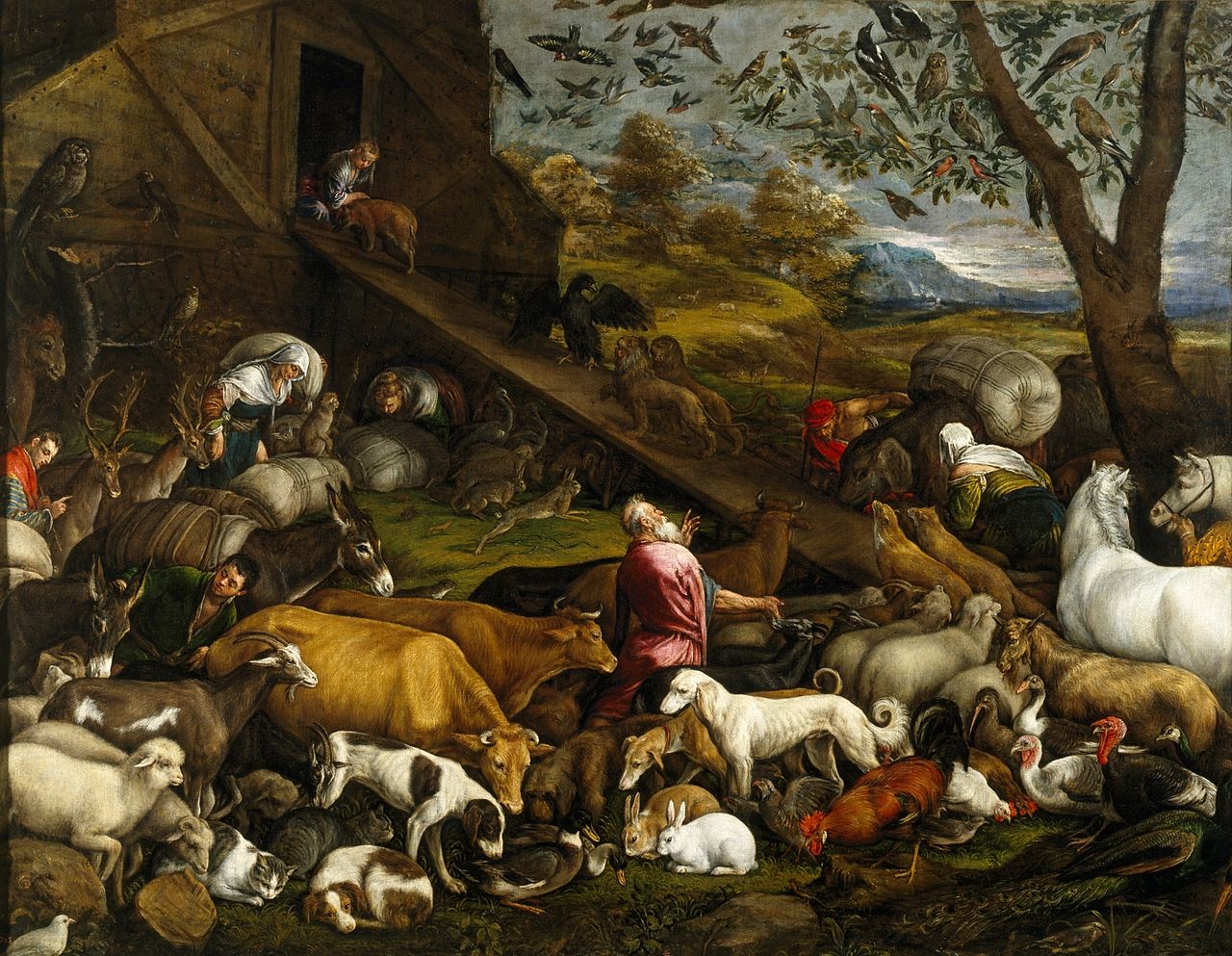
Where is the story of Noah?
The story of Noah begins in the genealogy of Genesis 5, where he is born, and ends at Genesis 9:29, where he dies. In between come the wickedness spreading over the earth, the ark, the flood, the return to dry land, the covenant sealed with the bow in the clouds and an awkward episode with a vineyard. The New Testament comes back to it several times: the Letter to the Hebrews counts Noah among the heroes of faith (Hebrews 11:7), and the First Letter of Peter sees the ark as a figure of Baptism (1 Peter 3:20–21).
It was one of the prompts of the Mustard Seed of 19 November: “Name something or someone in the story of Noah”. We accepted people, objects and events from Genesis 5:28 to 9:29, his grandfather Methuselah too, and the way the New Testament and the Church Fathers read the story. Here is how the answers ranked, from the rarest to the most common.
1. Methuselah, the grandfather
He was the rarest answer of the day. Methuselah was the son of Enoch, the patriarch who “was no longer here, for God took him” (Genesis 5:24), and the father of Lamech, Noah’s father. He is the longest-lived man in the whole Bible: “The whole lifetime of Methuselah was nine hundred and sixty-nine years; then he died” (Genesis 5:27).
One detail only appears if you do the sums. Methuselah was 187 when Lamech was born (Genesis 5:25), Lamech was 182 when Noah was born (Genesis 5:28), and Noah was 600 when the flood came (Genesis 7:6). Added up, that makes 969: by the figures in Genesis, Methuselah died in the very year of the flood. The text makes no comment, but grandfather and grandson shared six centuries.
2. Lamech, the father who hoped for relief
Lamech was 182 when his son was born, and when he named him he said: “This one shall bring us relief from our work and the toil of our hands” (Genesis 5:29). The words look back to the ground God had cursed after Adam’s sin, and in Hebrew Noah’s name sounds like the word for “rest”. The father hoped his son would bring a breathing space.
He should not be confused with the other Lamech in Genesis, the descendant of Cain who sings a song of vengeance (Genesis 4:23–24). Noah’s father lived seven hundred and seventy-seven years (Genesis 5:31) and died before the flood.
3. The door God shut
Once Noah, his family and the animals had gone in, Genesis adds a short line almost nobody remembers: “Then the LORD shut him in” (Genesis 7:16). Noah did not bolt the door himself. God did, like a father closing the front door so his children are safe before the storm.
And the flood did not start straight away. God had told him that in seven days he would bring rain for forty days and forty nights (Genesis 7:4). There was a week of waiting inside the ark under a still-dry sky. Noah’s faith, says Hebrews, was to obey when he was “warned about what was not yet seen” (Hebrews 11:7).
4. The Nephilim of Genesis 6
It is one of the most puzzling verses in the Bible. Before the flood, when the sons of God had relations with the daughters of human beings, “the Nephilim appeared on earth in those days, as well as later”, the heroes of old (Genesis 6:4). Many translations call them “giants”. The footnote of the New American Bible explains that belief in human beings of huge stature was widespread in the ancient world, and that Genesis uses it to show that even these heroes do not escape God’s judgement.
Who were “the sons of God”? St Augustine, in The City of God (XV, 23), concluded that they were men, descendants of Seth, and not angels. What matters for the story comes straight after: the LORD saw how great human wickedness was on the earth (Genesis 6:5).
5. The floodgates of the sky
Genesis gives the exact date the flood began: in the six hundredth year of Noah’s life, on the seventeenth day of the second month. That day “all the fountains of the great abyss burst forth, and the floodgates of the sky were opened” (Genesis 7:11). It is creation running backwards.
The rain lasted forty days, but the waters kept swelling for one hundred and fifty days (Genesis 7:24). On the seventeenth day of the seventh month “the ark came to rest on the mountains of Ararat” (Genesis 8:4), and the ground was only dry on the twenty-seventh day of the second month of the following year (Genesis 8:14). Noah spent more than a year inside the ark.
6. Three decks, a skylight and a door in the side
God’s instructions read like a carpenter’s: the ark was to be divided into compartments (Genesis 6:14), with “bottom, second and third decks”. It needed “an opening for daylight” near the top, and a door in its side (Genesis 6:16). When the waters went down, Noah “opened the hatch of the ark that he had made” to send out the raven and the dove (Genesis 8:6).
That side door caught St Augustine’s eye. In The City of God (XV, 26) he wrote that it signified the wound made in the side of the crucified Christ by the spear: through it, those who come to him enter. And from that side flowed blood and water (John 19:34), which the Catechism calls types of Baptism and the Eucharist, “the sacraments of new life” (Catechism, 1225).
7. Gopher wood, pitch and three hundred cubits
“Make yourself an ark of gopherwood… and cover it inside and out with pitch” (Genesis 6:14). Gopher wood appears nowhere else in the Bible, and no one knows exactly what it was. The New American Bible notes that it may have been cypress, whose Hebrew name sounds similar and which was widely used for shipbuilding in the ancient world. The pitch made it watertight.
“The length of the ark will be three hundred cubits”, fifty wide and thirty high (Genesis 6:15): roughly 150 by 25 by 15 metres. St Augustine noticed that these are the proportions of the human body, six times as long as it is broad and ten times as long as it is deep, and saw in them an image of the body in which Christ came into the world (The City of God, XV, 26).
8. Blood and the image of God
After the flood God blessed Noah and his sons (Genesis 9:1) and gave them the animals for food, with one condition: “Only meat with its lifeblood still in it you shall not eat” (Genesis 9:4). For the Bible, blood is life, and life belongs to God. Centuries later the Council of Jerusalem still asked Christians from a pagan background to abstain from blood (Acts 15:20).
Then comes one of the strongest lines in the Old Testament on human dignity: “Anyone who sheds the blood of a human being, by a human being shall that one’s blood be shed; for in the image of God have human beings been made” (Genesis 9:6). The Catechism quotes this verse when it explains the fifth commandment, and adds that this teaching holds for all time (Catechism, 2260).
9. The vineyard and the curse of Canaan
The story does not end with the rainbow. “Noah, a man of the soil, was the first to plant a vineyard. He drank some of the wine, became drunk, and lay naked inside his tent” (Genesis 9:20–21). His son Ham saw him and went to tell his brothers; Shem and Japheth instead covered him with a cloak, walking backwards so as not to look (Genesis 9:22–23).
When he woke, Noah cursed not Ham but Canaan, Ham’s son, and blessed Shem and Japheth (Genesis 9:24–27). The Bible does not hide that the righteous man saved from the flood also stumbled. Michelangelo painted this scene on the Sistine Chapel ceiling, as the last of its stories from Genesis.
10. Eight people, Baptism and the Church
Into the ark went Noah, his sons Shem, Ham and Japheth, his wife and his three daughters-in-law (Genesis 7:13): eight people. St Peter counts them and draws a conclusion: “a few persons, eight in all, were saved through water. This prefigured baptism, which saves you now” (1 Peter 3:20–21). So the Catechism says that “the Church has seen in Noah’s ark a prefiguring of salvation by Baptism” (Catechism, 1219), and the blessing of the water at the Easter Vigil still recalls the flood.
The Fathers went further and saw in the ark the Church herself. The Catechism says that, in an image dear to the Fathers, the Church “is prefigured by Noah’s ark, which alone saves from the flood” (Catechism, 845). St Cyprian of Carthage used that image in the third century, in his treatise on the unity of the Church, where he wrote: “He can no longer have God for his Father, who has not the Church for his mother.” St Augustine called the ark “a figure of the city of God sojourning in this world; that is to say, of the church”.
And the best known
- The animals: the answer given most often. God asked for a pair of every kind, male and female (Genesis 6:19), but of the clean animals, seven pairs (Genesis 7:2).
- The ark and the flood: with “forty days and forty nights” of heavy rain (Genesis 7:12). Noah built it just as he was told: “Noah complied; he did just as God had commanded him” (Genesis 6:22).
- The dove and the olive leaf: the second time Noah sent the dove out, it came back in the evening with “a plucked-off olive leaf” in its bill (Genesis 8:11). The third time it did not return.
- The raven: the first bird Noah sent out, which flew back and forth until the earth was dry (Genesis 8:7).
- Shem, Ham and Japheth: Noah’s three sons, born when he was five hundred (Genesis 5:32). From them, Genesis says, the whole earth was peopled (Genesis 9:19).
- Noah’s wife: went into the ark and was saved with him (Genesis 7:13), but the Bible never gives her name.
- Noah and his 950 years: “Noah was a righteous man and blameless in his generation” (Genesis 6:9). He lived three hundred and fifty years after the flood: “The whole lifetime of Noah was nine hundred and fifty years; then he died” (Genesis 9:28–29).
- The altar and the rainbow: on leaving the ark, “Noah built an altar to the LORD” (Genesis 8:20), and God sealed his covenant, setting his bow in the clouds as its sign (Genesis 9:13).
The open door
Noah’s story ends with a promise: God sets his bow in the clouds and binds himself never again to destroy the earth by flood. And the first Christians learned to read this story from the baptismal font: the water that once brought judgement now brings salvation, and the ark whose door God shut is now a Church with its door open.
Next time you go into a church, as you touch the holy water and make the sign of the cross, remember your Baptism and thank God that he brought you into the ark too.
Play today’s Mustard Seed
Seven prompts about the Bible, the saints and the Church, 30 seconds each. The rarer your correct answer, the more it’s worth.
Plant your seedHow to play →Frequently asked questions
- How old was Noah when the flood came?
- Six hundred (Genesis 7:6). He had fathered Shem, Ham and Japheth at five hundred (Genesis 5:32), lived three hundred and fifty more years after the flood and died at nine hundred and fifty (Genesis 9:28–29).
- How long was Noah in the ark?
- A little over a year. The flood began on the seventeenth day of the second month of the six hundredth year of his life (Genesis 7:11), and the earth was dry on the twenty-seventh day of the second month of the following year (Genesis 8:14). The rain lasted forty days, but the waters covered the earth for a hundred and fifty.
- What was the name of Noah’s wife?
- The Bible does not say. It names Noah and his three sons, Shem, Ham and Japheth, but of his wife and daughters-in-law it says only that they went into the ark with them (Genesis 7:13). The names that circulate come from later legends, not from Scripture.
- What does the rainbow mean in the story of Noah?
- It is the sign of the covenant God makes with Noah, his descendants and every living creature: never again will he destroy the earth by flood (Genesis 9:8–17). The Catechism explains that this covenant with all humanity remains in force during the times of the nations, until the universal proclamation of the Gospel (Catechism, 56–58).