Learn
The angel in Gethsemane, Susanna and Peter's mother-in-law: 10 people who cared for Jesus almost nobody names
We think of Jesus caring for others: touching lepers, feeding crowds, washing feet. But the Gospels also show the reverse: a Jesus who lets himself be cared for. There were those who fed him, those who supported him with their money, one who comforted him at night and those who prepared his body for the tomb. Some are famous. Others appear in a single line.
9 min read
A God who lets himself be cared for
One of the questions in the Mustard Seed of 25 November was: “Name someone who anointed Jesus or cared for his body.” We accepted the people, and the angels too, who according to the Gospels anointed Jesus or cared for him: wrapped him or protected him as a child, served him food, strengthened him in his agony, prepared or buried his body. We accepted Veronica because of the tradition of the Stations of the Cross. Simon of Cyrene, who carried the cross but did not tend Jesus' body, did not count, nor did the soldiers or the Magi.
The Sunday before, the feast of Christ the King, the Gospel had recalled Jesus' words: “Amen, I say to you, whatever you did for one of these least brothers of mine, you did for me” (Matthew 25:40). These people cared for Jesus in person. Here are ten, from the rarest answer to the best known.
1. The angel in Gethsemane
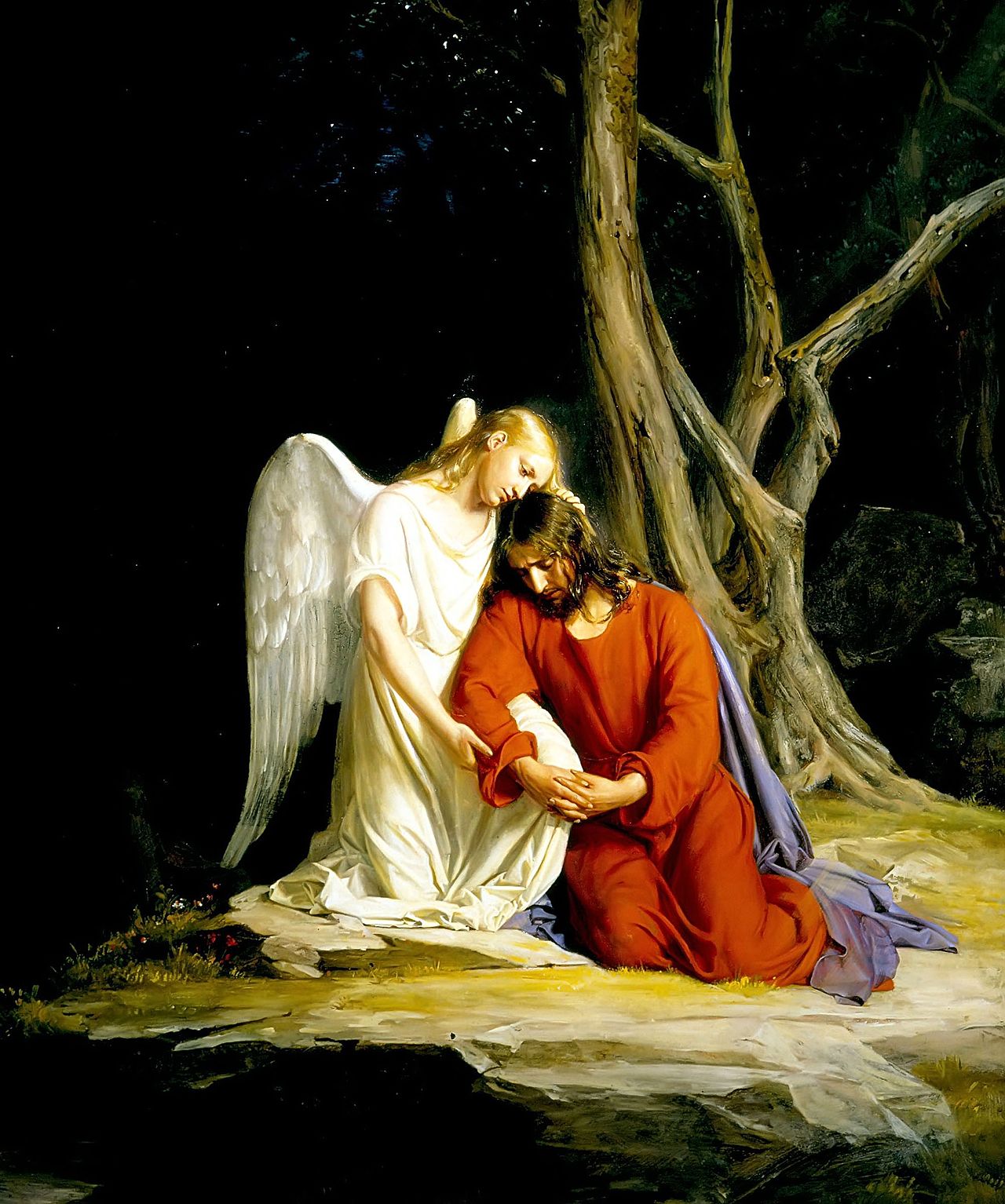
This was the rarest answer of the day. Only Luke tells it. On the Mount of Olives, the night before he died, Jesus withdrew from his disciples, knelt and prayed: “Father, if you are willing, take this cup away from me; still, not my will but yours be done.” And to strengthen him an angel from heaven appeared to him (Luke 22:42-43). Luke adds at once that, in his anguish, Jesus prayed so fervently that his sweat became like drops of blood falling on the ground (Luke 22:44).
These two verses are missing from some ancient manuscripts, but they are part of the text the Church recognises as inspired. It is a startling scene: the Son of God, truly man, needed comfort, and the Father sent it. The angel did not take the cup away; he gave him strength to drink it. Carl Bloch painted him embracing Jesus, in the picture that illustrates this article.
2. Susanna, who provided for him out of her resources
We know one thing about Susanna, and it is in Luke 8:1-3. Jesus was going through towns and villages proclaiming the Kingdom, with the Twelve and some women he had cured: Mary Magdalene, Joanna, “Susanna, and many others who provided for them out of their resources”. It is the only time the Bible names her.
That line says a lot. Jesus and his disciples did not live on air: someone paid for the bread, the lodging and the journeys, and many of those someones were women. Susanna belongs to that great crowd of people who keep the Church's mission going without ever appearing in a photograph. Caring for Jesus' body meant that too: making sure he had something to eat.
3. The angels in the desert
After his baptism, Jesus spent forty days fasting in the desert and was tempted by the devil. Mark sums it up in one mysterious sentence: “He was among wild beasts, and the angels ministered to him” (Mark 1:13). Matthew places it at the end of the temptations: “Then the devil left him and, behold, angels came and ministered to him” (Matthew 4:11).
The Greek word both evangelists use is the one used for waiting at table. After forty days of hunger, angels tended the Son of God made man, with his weak and weary body. It is one of the first scenes of the Gospel, and it looks ahead to Gethsemane: in both struggles, the desert and the garden, heaven was close.
4. Peter's mother-in-law
On leaving the synagogue at Capernaum, Jesus went to the house of Simon and Andrew. Simon's mother-in-law lay sick with a fever. Jesus approached, grasped her hand and helped her up; the fever left her, “and she waited on them” (Mark 1:29-31). Matthew, in the same story, says she rose and waited on him (Matthew 8:15).
It is the first healing miracle in Mark's Gospel, and it ends with a meal. In passing, the story tells us that Peter was married, something St Paul mentions too (1 Corinthians 9:5). Peter's mother-in-law answered her healing in the most natural way: by caring for the one who had cared for her.
5. Joanna, the wife of Herod's steward
Joanna appears in the same list as Susanna: she was the wife of Chuza, Herod Antipas's steward (Luke 8:3). In other words, a woman from the court of the king who had had John the Baptist beheaded, who put her money at the service of Jesus.
Luke names her again at the end. The women who had come from Galilee saw how Jesus was buried, went home to prepare spices and perfumed oils, and on the first day of the week went to the tomb. There they found the stone rolled away and heard the news of the Resurrection. Joanna was among them (Luke 23:55-24:10). She went to tend a dead body and met the Life.
6. St Joseph, who protected him as a child
St Joseph did not anoint Jesus, but few cared for his body more. When Herod sought to kill the child, Joseph rose by night, took the child and his mother and fled to Egypt (Matthew 2:13-14). Later he brought him back and raised him in Nazareth, where people knew him as “the carpenter's son” (Matthew 13:55).
Pope Francis, in the letter Patris Corde (2020), describes him as a tender father and a father of creative courage: someone who did not seek the limelight but sought to protect. The Gospels record not a single word of his. What they tell are his actions: rising, taking, setting out, caring.
7. Mary, the mother of James and Joses
At the cross, Mark names several women looking on from a distance, among them “Mary the mother of the younger James and of Joses”. He says that all of them had followed Jesus and ministered to him in Galilee (Mark 15:40-41). This Mary also saw where the body was laid (Mark 15:47), and when the sabbath was over she bought spices to go and anoint him (Mark 16:1).
Matthew calls her “the other Mary”, who stayed sitting facing the tomb with Mary Magdalene (Matthew 27:61). We know very little about her except the essential: she did not leave. She followed Jesus in Galilee, stood by him at the cross, did not abandon the tomb and came back with spices as soon as she could.
8. Salome, who bought spices
Salome appears twice in Mark's Gospel: among the women at the cross (Mark 15:40) and among those who, when the sabbath was over, bought spices to anoint Jesus' body (Mark 16:1). On the way to the tomb they were asking one another who would roll back the stone from the entrance (Mark 16:3).
Comparing the Gospel lists, many identify her with the mother of James and John, the sons of Zebedee (Matthew 27:56), though this is not certain. If so, she would be the same woman who once asked Jesus for the best places for her sons, and who ended up beside the cross, where the places were very different.
9. Veronica, who wiped his face
Veronica does not appear in the Gospels. We know her from tradition, above all from the sixth Station of the Cross: on the road to Calvary a woman came up to Jesus and wiped his face with a cloth, and his face was left imprinted on it. The name came to be linked with the phrase vera icon, “true image”. An ancient apocryphal text, the Acts of Pilate, calls the woman healed of a haemorrhage in the Gospel Bernice, or Veronica.
Even though her story is not in the Bible, her gesture is deeply evangelical: going up to someone who is suffering, despite the soldiers and the shouting, and doing the little that can be done. In St Peter's Basilica, one of the four great piers holding up the dome bears a statue of Veronica with the cloth, by the sculptor Francesco Mochi.
10. Martha, who served
Martha welcomed Jesus into her home at Bethany, and while her sister Mary listened at his feet, she was busy with all the serving. When she complained, Jesus answered her kindly: “Martha, Martha, you are anxious and worried about many things. There is need of only one thing” (Luke 10:41-42).
But we should not stop at the rebuke. Six days before the Passover, at the dinner in Bethany, John says simply: “Martha served” (John 12:2). That same evening Mary anointed Jesus' feet. Both sisters cared for him, each in her own way, and since 2021 the Church has celebrated them together, with their brother Lazarus, on 29 July.
And the best known
- Mary Magdalene: the most-given answer of the day. She stood by the cross (John 19:25), bought spices to anoint the body (Mark 16:1) and was the first to see the risen Lord (John 20:11-18). Since 2016 her day on 22 July has been ranked as a feast.
- Mary of Bethany: took a liter of costly perfumed oil made from genuine aromatic nard, anointed Jesus' feet and dried them with her hair, and the house was filled with the fragrance (John 12:3). Matthew and Mark tell of a woman who anointed him at Bethany, and Jesus said that what she had done would be told in memory of her wherever the Gospel is proclaimed (Mark 14:9).
- Joseph of Arimathea: a member of the council who courageously asked Pilate for Jesus' body, wrapped it in a linen cloth and laid it in his own new tomb (Mark 15:43-46; Matthew 27:57-60).
- Nicodemus: who had first come to Jesus at night, brought for the burial a mixture of myrrh and aloes weighing about one hundred pounds, more than thirty kilograms (John 19:39).
- The Virgin Mary: wrapped him in swaddling clothes and laid him in a manger (Luke 2:7), and stood by the cross (John 19:25).
- The sinful woman: in the house of Simon the Pharisee she wept at Jesus' feet, wiped them with her hair, kissed them and anointed them. Jesus said her many sins were forgiven, because she had shown great love (Luke 7:36-50).
Caring as if it were him
None of these people did anything spectacular. They served a meal, gave money, prepared spices, wiped a face, lent a tomb. Jesus let them care for him, and in the Gospel of Christ the King he told us where we can go on doing it: in the hungry, the sick, the prisoner, the one who is alone.
Today, visit, call or help someone who is sick or alone, with Martha's care, Susanna's generosity or Veronica's courage. As if you were caring for him, because you are.
Play today’s Mustard Seed
Seven prompts about the Bible, the saints and the Church, 30 seconds each. The rarer your correct answer, the more it’s worth.
Plant your seedHow to play →Frequently asked questions
- Who anointed Jesus?
- Mary of Bethany anointed his feet with nard (John 12:3); a woman identified with her anointed him in the house of Simon the leper (Matthew 26:6-13; Mark 14:3-9); and a sinful woman anointed his feet in the house of Simon the Pharisee (Luke 7:36-50). After his death, Nicodemus brought myrrh and aloes, and the women bought spices to anoint his body.
- Who buried Jesus?
- Joseph of Arimathea, who asked Pilate for the body and laid it in his own new tomb, and Nicodemus, who brought myrrh and aloes. They bound it in burial cloths with the spices, according to Jewish custom (John 19:38-42). The women from Galilee watched where he was laid.
- Is Veronica in the Bible?
- No. Her story comes from tradition and is remembered in the sixth Station of the Cross. An apocryphal text, the Acts of Pilate, gives the name Bernice, or Veronica, to the woman healed of a haemorrhage.
- Which angel comforted Jesus in Gethsemane?
- Luke's Gospel says only that “to strengthen him an angel from heaven appeared to him” (Luke 22:43), without naming him. Luke is the only evangelist who records this detail.