Learn
Cuthbert, Crescentia, Columbanus: 10 saints starting with C hardly anyone names
Asked for a saint beginning with C, you probably think of Catherine, Clare or Cecilia. But the letter holds some surprising stories: a bishop whose feet were dried by otters, a poor weaver who got into the convent thanks to a Protestant mayor, a slave who became pope, and a hermit who gave up the papacy after five months.
10 min read · Level: Advanced
Far more than Catherines
C is one of the most generous letters in the calendar of saints. It has several famous Catherines, Clare, the friend of Francis, Cecilia, patron of music, and Carlo Acutis. But behind those names there are popes, martyrs, missionary monks and women hidden away in convents whom hardly anyone remembers.
It was one of the questions in the Mustard Seed of 28 November, the day of St Catherine Labouré: “Name a saint whose name starts with C.” We accepted canonized saints, not beati, which is why Ceferino Namuncurá, who is Blessed, did not count. The most common answer was Catherine of Alexandria. Here are the ten worth the most, from the rarest to the best known.
1. Cuthbert of Lindisfarne, the bishop and the otters
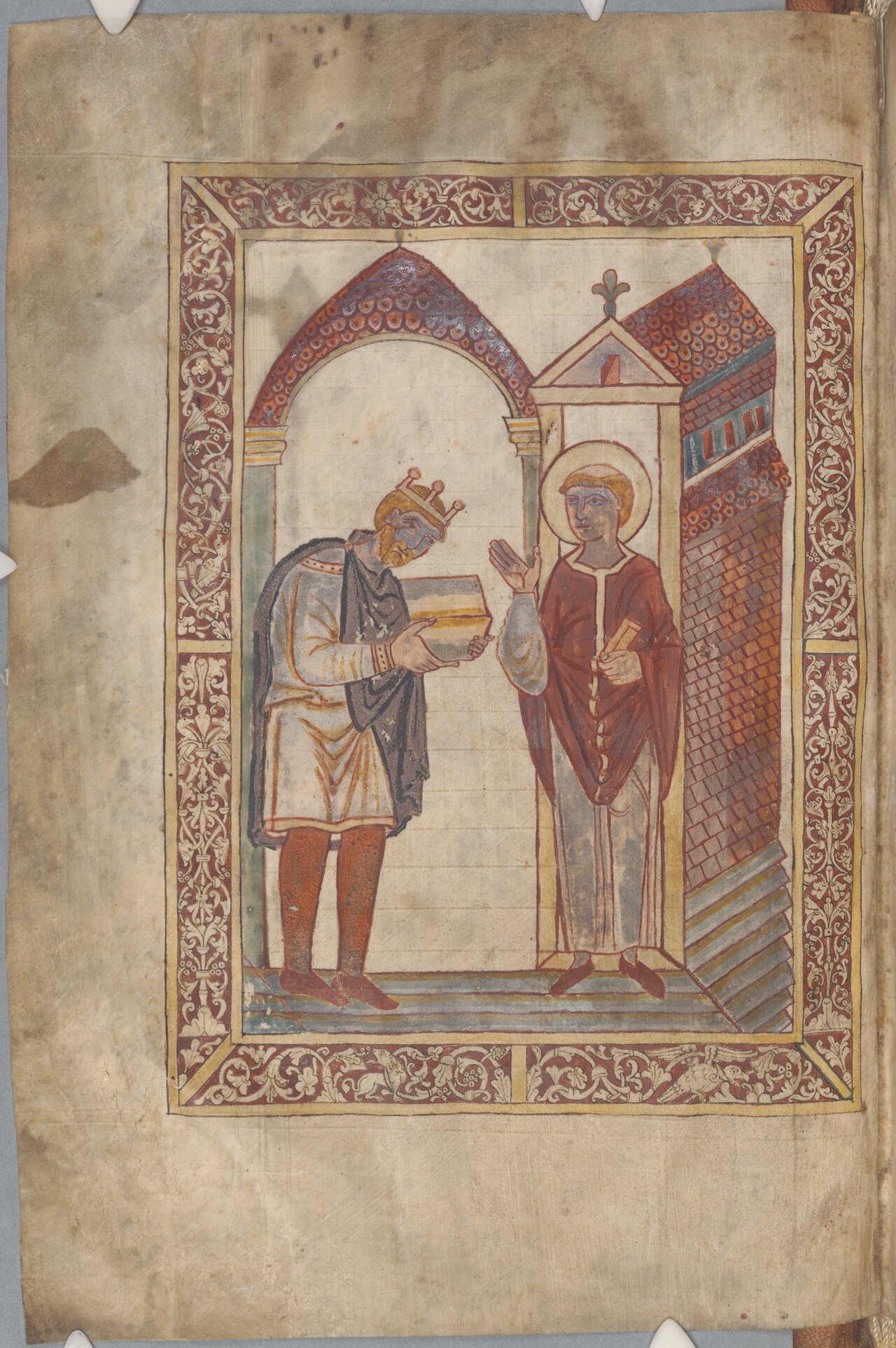
Cuthbert was born around 635 in the north of England and as a young man looked after sheep. One night in 651, as St Bede tells it, he saw angels carrying a holy soul up to heaven; shortly afterwards he learned that St Aidan, Bishop of Lindisfarne, had died that night. He then became a monk at Melrose, was prior of Lindisfarne, and ended up living as a hermit on the island of Farne, off the coast.
Bede relates that on a visit to Coldingham Cuthbert spent the night praying up to his neck in the sea, and that when he came out two otters dried and warmed his feet. In 685 he was made bishop almost against his will, but two years later he went back to his island and died there on 20 March 687. Eleven years later his body was found incorrupt. When the Vikings came, the monks fled carrying his coffin for years, until in 995 they stopped at Durham, where his tomb is today, in the cathedral.
2. Crescentia Höss, who got in thanks to a Protestant mayor
Anna Höss was born on 20 October 1682 in Kaufbeuren, Bavaria, a town that was then mostly Protestant. She was a wool weaver’s daughter and wanted to join the Franciscan sisters in her town, but her family could not pay the dowry. Help came from an unexpected quarter: the Protestant mayor bought a tavern next to the convent that had been disturbing the nuns, gave it to them, and asked only that they admit Anna in return. She entered in 1703 as Maria Crescentia.
The superior did not want her and treated her as a burden: she was given the worst jobs, and her cell was taken from her and given to a novice who had brought a dowry. She bore it without complaint. In time she became portress, novice mistress and, in 1741, the community elected her superior against her wishes. She used to say that God wants the convent rich in virtue, not in worldly goods. She died on Easter Sunday, 5 April 1744. St John Paul II canonized her on 25 November 2001.
3. Charles Lwanga, head of the royal pages
Charles Lwanga was head of the pages at the court of Mwanga, King of Buganda, in present-day Uganda. He was baptized on 15 November 1885 by a White Fathers missionary, on the very day the king had Joseph Mukasa, his predecessor in charge of the Christian pages, put to death. Lwanga took his place: he went on teaching the boys the catechism and protected them from the king’s abuse.
The king ordered the death of any Christians who would not renounce their faith. On 3 June 1886, at Namugongo, Charles Lwanga and many of his companions were burned alive. St Paul VI canonized the twenty-two Catholic martyrs of Uganda on 18 October 1964, in the middle of the Second Vatican Council, and in his homily he chose to remember the Anglicans who had also died for the name of Christ. In 1969 he went to pray at Namugongo. Their memorial is 3 June.
4. Columbanus, the Irishman who spoke of “all Europe”
Columbanus was born around 543 in Leinster, Ireland, and became a monk at Bangor. At about fifty he left his island with twelve companions to preach on the Continent. In what is now France he founded the monasteries of Annegray, Luxeuil and Fontaine, wrote a rule for his monks and spread private, frequent confession, which in time took hold throughout the Church.
He did not mince his words: he rebuked King Theuderic for his adulterous life, and in 610 he was expelled from the kingdom. He travelled up the Rhine to Lake Constance, where his disciple Gall stayed behind, and ended up in Italy, where he founded the monastery of Bobbio. He died there on 23 November 615. Benedict XVI pointed out that a letter of his to Pope Gregory the Great contains the first known use of the phrase “totius Europae”, “of all Europe”, and called him one of the Fathers of Europe. His memorial is 23 November.
5. Claude de la Colombière, the faithful friend
Claude was born on 2 February 1641 in the Dauphiné, France, and became a Jesuit. In 1675 he was made superior of the small house at Paray-le-Monial, and there he met St Margaret Mary Alacoque, a Visitation nun who said the Lord had promised to send her his “faithful servant and perfect friend”. He listened to her, believed her and helped her spread devotion to the Sacred Heart of Jesus.
In 1676 he went to London as preacher to the Duchess of York. Two years later he was falsely accused in the so-called Popish Plot, spent some weeks in a harsh prison and was expelled from England, his health ruined. He returned to Paray and died there on 15 February 1682. He left a well-known prayer, the “Act of Confidence”, in which he places all his hope in God. St John Paul II canonized him on 31 May 1992.
6. Katharine Drexel, the heiress who gave it all away
Katharine Drexel was born on 26 November 1858 in Philadelphia, the daughter of one of the richest bankers in the United States. With her inheritance she began funding missions among Native Americans. At an audience in Rome she asked Pope Leo XIII to send missionaries, and the Pope surprised her by suggesting she become a missionary herself.
She took him at his word. In 1891 she founded the Sisters of the Blessed Sacrament to serve Native Americans and African Americans, in an age of racial segregation, and spent her fortune on schools and missions. In 1925 she founded Xavier University of Louisiana in New Orleans. Illness left her almost immobile for her last eighteen years, which she spent in prayer before the Blessed Sacrament. She died on 3 March 1955, and St John Paul II canonized her on 1 October 2000.
7. Cornelius and Cyprian, the pope and the bishop who were friends
Cornelius was elected pope in 251, after the persecution of Decius. Many Christians had denied the faith out of fear and were now asking to come back, and Cornelius was willing to receive them after penance. A Roman priest, Novatian, thought him far too lenient and had himself proclaimed antipope. Cyprian, Bishop of Carthage, took Cornelius’s side and wrote that no one can have God as Father who does not have the Church as mother. Cornelius died in exile at Centumcellae, today’s Civitavecchia, in 253.
Cyprian followed him five years later. He had been a wealthy, cultured pagan who converted at 35. In the persecution of Valerian he was tried at Carthage, and when he heard the death sentence he answered “Deo gratias”, thanks be to God. According to the acts of his martyrdom, he had twenty-five gold coins given to the executioner. He was beheaded on 14 September 258. Both are named in Eucharistic Prayer I, and the Church celebrates them together on 16 September.
8. Camilla Battista da Varano, the princess who chose the Passion
Camilla was born in 1458 in Camerino, Italy, the daughter of the lord of the city. As a girl, after hearing some friars preach, she began to meditate on the Passion of Christ every Friday. She loved music, singing, dancing and court life, but that habit grew until it became a vocation. Her father wanted her married and opposed her for more than two years; in the end he gave way, and in 1481, at 23, Camilla joined the Poor Clares of Urbino, taking the name Battista.
She went on to found a monastery in Camerino, where she was abbess several times, and wrote about the inner sufferings of Jesus in his Passion. Benedict XVI said she chose to enter the Heart of Jesus and drown in the ocean of his sufferings. She knew suffering at first hand, too: in 1502, when Cesare Borgia seized Camerino, her father and three of her brothers were killed. She died on 31 May 1524, and Benedict XVI canonized her on 17 October 2010.
9. Callixtus, from slave to pope
What little we know of Callixtus’s early life comes from an opponent of his, St Hippolytus, so it has to be read with care. According to him, Callixtus was the slave of a Christian named Carpophorus, who entrusted him with a bank; Callixtus lost the money, tried to escape by sea and was sentenced to hard labour and then to the mines of Sardinia. Released along with other Christians, he returned to Rome.
Pope Zephyrinus put him in charge of the cemetery on the Appian Way that bears his name today, the Catacombs of St Callixtus, where many popes were buried. He was elected pope around 217, and Hippolytus accused him of being too lenient with repentant sinners, but the Church of Rome sided with Callixtus. He died around 222 and tradition venerates him as a martyr. His memorial is 14 October.
10. Celestine V, the hermit who resigned
Pietro da Morrone was an elderly hermit in the Abruzzi when, on 5 July 1294, after more than two years without a pope, the cardinals elected him. He took the name Celestine V and was crowned in the basilica of Collemaggio in L’Aquila. But he had no idea how to deal with the intrigues of the Curia, and on 13 December, five months later, he resigned the papacy.
His successor, Boniface VIII, feared someone might use him to divide the Church and kept him confined in the castle of Fumone, where he died on 19 May 1296. Clement V canonized him in 1313. His story came back into the news in 2009: after the L’Aquila earthquake, Benedict XVI visited his tomb and left his pallium on it. Four years later, Benedict resigned too.
And the best-known ones
- Catherine of Alexandria: the most common answer of the day. According to tradition, a learned young woman who debated pagan philosophers and died a martyr; her story is full of legend. Her memorial is 25 November.
- Catherine of Siena and Catherine Labouré: the Doctor of the Church who persuaded the pope to return to Rome, and the Daughter of Charity to whom Our Lady showed the Miraculous Medal, the saint of the day this question was played.
- Carlo Acutis: the young man of the internet and the Eucharist, canonized on 7 September 2025.
- Clare of Assisi and Cecilia: St Francis’s friend who founded the Poor Clares, and the Roman martyr who is patron of music.
- Charles Borromeo and Cajetan: the Archbishop of Milan who put the Council of Trent into practice, and the patron of bread and work.
- Charbel and Christopher: the Maronite hermit of Lebanon, and the giant who, according to legend, carried the Christ Child across a river.
Names like ours
A shepherd, a weaver, a slave, an heiress, a page. The saints bear names like ours and lived in circumstances as varied as ours. None of them became a saint in spite of their life, but in the middle of it.
If your name, or the name of someone you love, begins with C, look up their saint today and ask them to pray for you both.
Play today’s Mustard Seed
Seven prompts about the Bible, the saints and the Church, 30 seconds each. The rarer your correct answer, the more it’s worth.
Plant your seedHow to play →Frequently asked questions
- Is Ceferino Namuncurá a saint?
- Not yet. Ceferino Namuncurá, the young Mapuche from Argentina who wanted to become a Salesian priest, was beatified in 2007. Canonization requires another miracle attributed to his intercession, so for now he is called Blessed.
- Which saints starting with C are celebrated in November?
- St Charles Borromeo on the 4th, St Cecilia on the 22nd, St Clement I and St Columbanus on the 23rd, St Catherine of Alexandria on the 25th and St Catherine Labouré on the 28th, among others.
- Which pope resigned before Benedict XVI?
- The most famous case is St Celestine V, who resigned on 13 December 1294, five months after his election. Gregory XII also resigned, in 1415, to bring the Western Schism to an end.
- Who are the martyrs of Uganda?
- They are twenty-two Catholics, many of them young pages at the court of King Mwanga of Buganda, killed between 1885 and 1887 for refusing to give up their faith. The best known is St Charles Lwanga. St Paul VI canonized them on 18 October 1964, and their memorial is 3 June.