Learn
Sylvester, Adeodatus and Marinus: 10 repeated papal names hardly anyone remembers
John is the name borne by more popes than any other: twenty-one, even though the last was John XXIII. But the list of repeated names is far longer and stranger: a name meaning “given by God”, one that was twice mistaken for Martin, one first carried by a former slave, and one nobody has wanted since the man who bore it resigned.
10 min read
Why do popes change their name?
It was one of the questions in the Mustard Seed of 10 November, the feast of St Leo the Great: “Name a papal name used by more than one pope”. We accepted any papal name borne by at least two legitimate popes according to the list in the Annuario Pontificio, with or without the number. Antipopes did not count, and nor did names used by a single pope, such as Francis, Linus or Cletus.
For five centuries popes kept their baptismal names. The first to change his was John II, in 533: he had been christened Mercurius, after the pagan god, and thought it unfitting for the bishop of Rome. Other isolated cases followed, and around the turn of the first millennium the custom became almost a rule. The last two popes to keep their own names were Adrian VI, in 1522, and Marcellus II, in 1555.
A new name is usually a programme: it honours a saint or an earlier pope and signals where the new pope wants to lead the Church. That is why so many recur. Here is how the answers ranked, from the rarest to the most common.
1. Sylvester, the pope of Constantine and of the year 1000
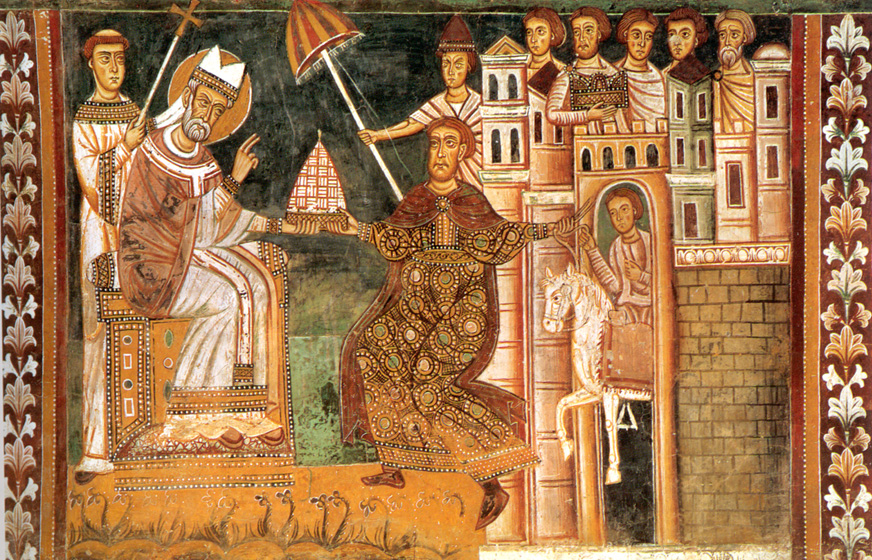
It was the rarest answer of the day. Three legitimate popes were called Sylvester. The first, Sylvester I, led the Church from 314 to 335, just as the Emperor Constantine had stopped persecuting Christians. The Council of Nicaea (325) met in his time, and he sent two priests to represent him. A story much loved in the Middle Ages had him baptising Constantine and curing him of leprosy; it is only a legend, since the emperor was baptised on his deathbed in 337, two years after the pope died. His feast is on 31 December, which is why in many countries New Year’s Eve is called “St Sylvester’s”.
Sylvester II, elected in 999, was the pope of the year 1000. Born Gerbert of Aurillac, he was the first French pope and one of the most learned men of his age: he taught mathematics and astronomy and helped spread in Europe the numerals we now call Arabic. He chose his name to recall Sylvester I, while his friend the Emperor Otto III dreamt of being a new Constantine. Sylvester III held the see for a few weeks in 1045, in a very troubled period, and the Annuario Pontificio keeps him on the list of popes. The man who called himself Sylvester IV, in 1105, was an antipope.
2. Adeodatus, “given by God”
Adeodatus is the Latin form of a name that also appears as Deusdedit: both mean “given by God”. Two popes bore it. Adeodatus I (615–618), a Roman, is venerated as a saint; the Liber Pontificalis remembers him for his closeness to his clergy and for caring for the sick during an epidemic that followed an earthquake in Rome. His feast is on 8 November.
Adeodatus II (672–676) was a monk of the Roman monastery of St Erasmus and went on living simply as pope. Many readers know the name from elsewhere: Adeodatus was also the name of St Augustine’s son, the brilliant boy his father speaks of so tenderly in the Confessions.
3. Callixtus, from slave to the pope of the noonday bell
Three popes took this name. The first, Callixtus I (c. 217–222), had been a slave. Before he became pope, Pope Zephyrinus put him in charge of the cemetery on the Appian Way that still bears his name, the Catacombs of St Callixtus, where several third-century popes were buried. Tradition honours him as a martyr. Against the rigorists of his day, he held that the Church can forgive repentant sinners.
Callixtus II (1119–1124) signed the Concordat of Worms in 1122, ending the long struggle with the emperor over who appointed bishops, and called the First Lateran Council. Callixtus III (1455–1458) was a Valencian named Alfonso de Borja; he ordered the retrial of Joan of Arc, which cleared her name in 1456. That same year he asked for church bells to be rung at midday so that people would pray for the defenders of Belgrade. It is also said that he excommunicated Halley’s Comet, but that is a legend with no document behind it.
4. Damasus, the pope who commissioned the Vulgate
Two popes were called Damasus, and they could hardly be more different. St Damasus I (366–384) asked his secretary, St Jerome, to revise the Latin translations of the Gospels. That work grew into the Vulgate, the Latin Bible the Western Church read for more than a thousand years. Damasus also sought out the martyrs’ tombs in the catacombs, restored them and adorned them with poems carved in marble, in an elegant script designed by the calligrapher Furius Dionysius Filocalus.
Damasus II, by contrast, was pope for just twenty-three days in 1048. A German put forward by the emperor, he died at Palestrina in the height of summer, probably of malaria. His is one of the shortest pontificates in history.
5. Felix, the name with one number too many
There were three legitimate popes called Felix, yet their numbers run to IV. The reason is that Felix II, who held the see between 355 and 365 while Pope Liberius was in exile, was counted as a pope for centuries, and those who came after kept that numbering. Today the Annuario Pontificio lists him among the antipopes, but nobody renumbered his successors.
Felix III (483–492) was an ancestor of St Gregory the Great, who mentions him in his writings. Felix IV (526–530) turned two buildings in the Roman Forum into a church dedicated to the doctor saints Cosmas and Damian; the mosaic in its apse survives. And the name has an odd ending: Felix V was Amadeus VIII of Savoy, a widowed duke elected in 1439 by the Council of Basel and usually reckoned the last antipope.
6. Marinus, the one mistaken for Martin
Marinus I (882–884) and Marinus II (942–946) were popes in a dark time for Rome. Their reigns left little trace, but their name left a mark on the list: medieval copyists confused Marinus with Martinus and counted them as Martin II and Martin III.
So when a French cardinal was elected in 1281 and chose the name Martin, he took the number IV, although there had been only one Pope Martin before him: St Martin I, who died in exile in Crimea in 655 for defending the truth that Christ has both a divine and a human will. Martin IV’s namesake, Martin V, was the pope who ended the Western Schism in 1417. So there have been three Popes Martin, numbered I, IV and V.
7. Paschal, the pope with a square halo
Two popes were called Paschal. Paschal I (817–824) built churches all over Rome and had himself portrayed in their mosaics: at Santa Prassede, Santa Cecilia and Santa Maria in Domnica he appears with a square halo, the sign artists used for someone still alive when the work was made. He moved the remains of St Cecilia from the catacombs to her church in Trastevere.
Paschal II (1099–1118) reigned for almost nineteen years, in the thick of the quarrel with the emperor over the appointment of bishops. The name recalls Easter, the Pasch, and perhaps that is why it sounds so Christian; even so, no pope has used it again in nine hundred years.
8. Sergius, who would not be Peter II
Four popes were called Sergius. St Sergius I (687–701), from a Syrian family, ordered, according to the Liber Pontificalis, that the “Lamb of God” be sung at Mass during the breaking of the bread, and organised processions for the feasts of Our Lady. Every time we say at Mass “Lamb of God, you take away the sins of the world”, we repeat something he wanted sung.
Sergius IV (1009–1012) had been christened Pietro, that is, Peter. According to tradition he changed his name because he did not dare to call himself Peter II, after the first pope. Peter Canepanova had done the same in 983, taking the name John XIV. No pope has used the apostle’s name since.
9. Stephen, the pope who isn’t counted
Nine legitimate popes were called Stephen, but books number them in two ways, as Stephen II (III) or Stephen IX (X). The cause is a priest elected in March 752 who died three days later, before he could be consecrated. For centuries he was counted as Stephen II, but since 1961 the Annuario Pontificio has left him out, because in those days a pope’s reign began with his consecration.
St Stephen I (254–257) held that those baptised by heretics must not be baptised again, and argued the point with St Cyprian of Carthage. Stephen II (III) crossed the Alps in 754 to ask the Frankish king Pepin for help against the Lombards and anointed him king; from that pact the Papal States were born.
10. Celestine, the name of the pope who resigned
Five popes were called Celestine. St Celestine I (422–432) sent his legates to the Council of Ephesus, which in 431 proclaimed Mary the Mother of God, and that same year sent the deacon Palladius as the first bishop of the Christians of Ireland, shortly before St Patrick’s mission.
The best known is St Celestine V. Born Pietro da Morrone, he was a hermit of about eighty when he was elected in 1294, after more than two years without a pope. Five months later, seeing that he could not govern, he issued a decree allowing a pope to resign, and resigned. In 2009, after the L’Aquila earthquake, Benedict XVI visited his tomb and left on it the pallium he had received at the start of his pontificate. Since 1294 no pope has chosen the name Celestine.
And the best-known
- Clement: was, together with Gregory, the answer given most often. Fourteen popes bore it, from St Clement I, who around the year 96 wrote a letter to the Christians of Corinth, to Clement XIV, who suppressed the Jesuits in 1773.
- Gregory: sixteen popes, among them St Gregory the Great, who sent missionaries to England, and Gregory XIII, who in 1582 gave us the calendar we use.
- John: the most used name: twenty-one popes, although the numbering reaches John XXIII, because there was never a John XX and John XVI was an antipope.
- Benedict: fifteen legitimate popes numbered up to XVI, because Benedict X was an antipope. The last, Benedict XVI, resigned in 2013.
- Urban, Innocent, Pius and Sixtus: eight, thirteen, twelve and five popes. Urban II called the First Crusade, Innocent III approved St Francis’s way of life, Pius XII led the Church through the Second World War and Sixtus IV built the Sistine Chapel.
- John Paul: the first double name: John Paul I chose it in 1978 to honour John XXIII and Paul VI, and when he died thirty-three days after his election, St John Paul II took it again.
- Leo: fourteen popes, from St Leo the Great, whose feast it was that day, to Leo XIV. They have an article of their own.
A name for a mission
When a pope chooses his name, he is not picking an ornament: he places himself under someone’s protection and announces a task. Two days after his election, Leo XIV told the cardinals that he had been thinking above all of Leo XIII and the Church’s social teaching. Something similar is true of all of us: at baptism God called us by name, and often that name belongs to a saint.
Today you could do two simple things. Pray a Hail Mary for Pope Leo, that he may be faithful to his name and his mission. And find out who the saint of your own name is, and ask him or her to walk with you.
Play today’s Mustard Seed
Seven prompts about the Bible, the saints and the Church, 30 seconds each. The rarer your correct answer, the more it’s worth.
Plant your seedHow to play →Frequently asked questions
- What is the most common papal name?
- John, with twenty-one legitimate popes. It is followed by Gregory (16), Benedict (15), Clement (14), Leo (14), Innocent (13) and Pius (12).
- Why has there never been a Pope Peter II?
- Out of respect for St Peter, the first pope. No law forbids it, but it is a very old custom. At least two popes christened Peter changed their names so as not to be Peter II: John XIV in 983 and Sergius IV in 1009.
- Why is there no Pope John XX?
- Because medieval chroniclers miscounted and added one John too many. When Peter of Spain was elected in 1276 he took the number XXI to respect that numbering, and so the number XX was left empty for good.
- Can a pope keep his baptismal name?
- Yes. Changing it is a custom, not an obligation. The last popes to keep their own names were Adrian VI, in 1522, and Marcellus II, in 1555, the pope to whom Palestrina dedicated his Missa Papae Marcelli.