Learn
Ratisbonne, the armchair and the gems without light: 10 things about the Miraculous Medal hardly anyone knows
The Miraculous Medal was born in 1830 in a chapel on the Rue du Bac in Paris, when the Virgin Mary showed its design to a novice, St Catherine Labouré. Almost everyone knows it has twelve stars and the prayer “O Mary, conceived without sin”. Fewer people know the stories that followed: a banker converted in Rome, an armchair that is still kept, a cholera epidemic and a Polish Franciscan who called it his weapon. Here they are, with what each part of the medal means.
10 min read
A medal with two faces
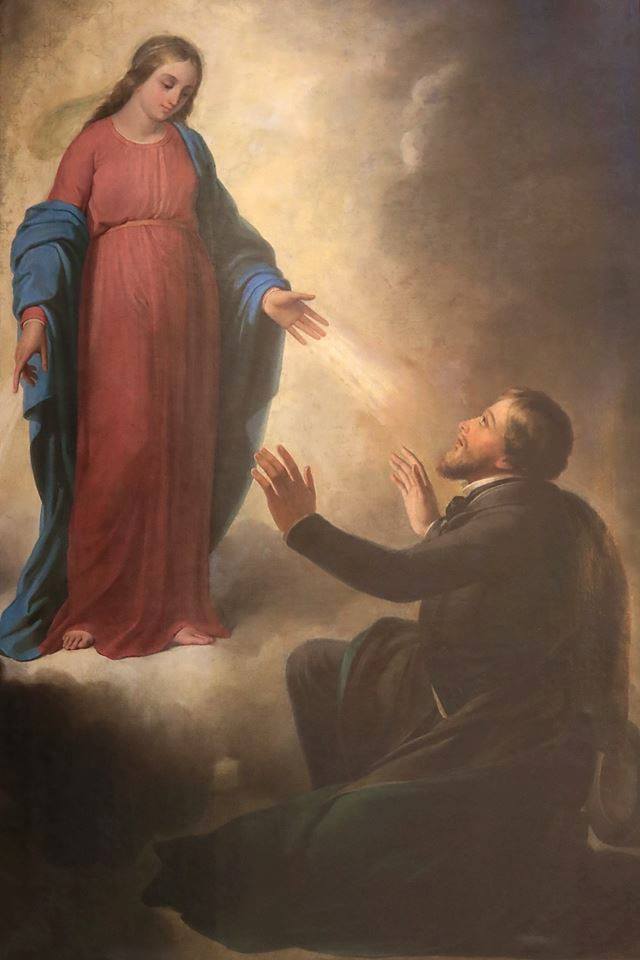
On 27 November 1830, at about half past five in the evening, St Catherine Labouré saw the Virgin standing on the globe of the world, treading on a serpent, with rays of light streaming from her hands. Around her ran a prayer in golden letters; then the image turned and showed the reverse: an M with a cross, two hearts and twelve stars. Catherine heard: “Have a medal struck after this model. Those who wear it with confidence will receive great graces.” Its official name is the Medal of the Immaculate Conception, but people very soon began to call it “miraculous”.
It was one of the prompts of the Mustard Seed of 27 November, its feast day: “Name something on the Miraculous Medal or in its story”. We accepted the elements on both faces and the people, places, dates and events of its history. We tell the life of the visionary in a separate article on St Catherine Labouré. Here are the answers, from the rarest to the most common.
1. Alphonse Ratisbonne
The rarest answer of the day, and nobody gave it. Alphonse Ratisbonne was a young Jewish banker from Strasbourg, born in 1814, and deeply hostile to the Church, especially after his brother Théodore became a Catholic. On a journey to the East he stopped in Rome, where a Catholic friend pressed him until he agreed, rather reluctantly, to wear the medal.
On 20 January 1842 he wandered into the church of Sant'Andrea delle Fratte and saw the Virgin exactly as she appears on the medal. He came out converted. The Church recognised the event that same year, and the chapel where it happened is now called the Chapel of the Madonna of the Miracle. Ratisbonne was ordained a priest in 1847 and spent the rest of his life, with his brother, working for the Congregation of Our Lady of Sion. He died in 1884 at Ein Karem, near Jerusalem: the very village where, according to tradition, Mary visited Elizabeth.
2. The Children of Mary and the Miraculous Medal Association
According to Catherine, the Virgin asked not only for a medal: she also wanted an association of young people consecrated to her, and she gave Fr Aladel the task of founding it. From 1835 the first groups of Children of Mary formed in France, mostly in schools run by the Daughters of Charity, and on 20 June 1847 Pope Pius IX approved them. They wore the Miraculous Medal on a blue ribbon. Their heir today is the Vincentian Marian Youth, present in dozens of countries.
Soon after the first medals, associations were also set up to spread the devotion, the first at the motherhouse of the Vincentian Fathers in Paris. St Pius X recognised them in 1905 and gave them a charter in 1909: this is the Association of the Miraculous Medal, which in many parishes organises a statue of Our Lady that visits families from house to house.
3. Catherine’s body
Catherine died on 31 December 1876 and was buried at the house in Reuilly, on the outskirts of Paris, where she had served the elderly. In 1933, during the process for her beatification, her tomb was opened and her body was found remarkably well preserved. That year it was moved to the chapel on the Rue du Bac.
It rests there today in a glass reliquary placed exactly where the apparition of 27 November took place. Many pilgrims kneel in front of it without realising they are looking at the very spot where Catherine first saw the design of the medal they wear around their necks.
4. Catherine’s silence
While the medal was being handed out by the million, the visionary remained unknown. For forty-six years only her confessor knew it was her. Catherine looked after old people, kept the door and the henhouse, and listened to other sisters talking about “the sister of the apparitions” without saying a word.
Only in 1876, a few months before she died, did she tell her superior. Pius XII summed up her life with two words from the Imitation of Christ: “Ama nesciri”, love to be unknown. The most widespread medal in the world came from a woman who did not want to be known.
5. The gems that gave no light
It is one of the loveliest details in Catherine’s account. In the apparition of 27 November the Virgin’s fingers were covered with rings set with precious stones, and from almost all of them rays of light fell towards the earth. The Virgin explained that the rays were the graces she pours out on those who ask for them.
But some of the gems gave no light. Those, she said, were the graces nobody asks for. The rays on the medal say that God is generous; the dark gems say that very often the ones who fall short in trust are us.
6. The child who woke her
The story began on the night of 18 to 19 July 1830, the eve of the feast of St Vincent de Paul. At about half past eleven Catherine heard someone calling her by name. At the foot of her bed stood a child dressed in white, who told her: “The Blessed Virgin is waiting for you.”
She followed him to the chapel, with the whole way lit up. She always believed he was her guardian angel. It is a very simple scene: before the medal, the rays and the stars, the Virgin sent someone to fetch a twenty-four-year-old novice in the middle of the night.
7. The armchair where Mary sat
That same night, in the chapel, Catherine heard a rustle like silk, and the Virgin sat down in the director’s armchair beside the altar. Catherine knelt and rested her hands on Mary’s knees. They talked for a long time, and she remembered it as the sweetest moment of her life.
The armchair still exists. It was put back in the chapel on the Rue du Bac in 1880 and is now one of the places where pilgrims pray most. The message of that night is there too: “Come to the foot of this altar. Here graces will be poured out on all who ask for them with confidence.”
8. The cholera epidemic
Catherine’s confessor, Fr Jean-Marie Aladel, was slow to believe her. When he finally consulted the Archbishop of Paris, Mgr de Quélen, the archbishop approved the medal, and the first ones were struck on 30 June 1832. Paris was in the grip of a cholera epidemic, and the Daughters of Charity handed them out to the sick and the poor.
Accounts of cures, conversions and protection began to arrive, and people started calling it “the miraculous medal”. According to the chapel on the Rue du Bac, more than half a million had been distributed by 1834 and more than a million by 1835. The chapel itself keeps a memory of those months: the marble statue of Our Lady above the high altar was carved from blocks given in thanks for the sisters’ care during the epidemic.
9. A sacramental, not a lucky charm
The medal does not work on its own. It is a sacramental, one of the sacred signs the Church blesses to help us pray. The Catechism explains that “sacramentals do not confer the grace of the Holy Spirit in the way that the sacraments do, but by the Church’s prayer, they prepare us to receive grace and dispose us to cooperate with it” (Catechism, 1670).
The Catechism also warns that “to attribute the efficacy of prayers or of sacramental signs to their mere external performance, apart from the interior dispositions that they demand, is to fall into superstition” (Catechism, 2111). That is why the Virgin asked for it to be worn “with confidence”: the medal around your neck is a reminder to turn to her, not an insurance policy against bad luck.
10. St Maximilian Kolbe
In 1917, as a young Franciscan studying in Rome, Maximilian Kolbe was struck by the story of Ratisbonne. On 16 October that year he founded the Militia of the Immaculata with six companions, and asked all its members to wear the Miraculous Medal as a sign of their consecration to Mary. He called it a heavenly weapon and gave it away tirelessly, convinced that it was enough for someone to agree to wear it while others prayed for him.
On 29 April 1918 he celebrated his first Mass in the chapel of Sant'Andrea delle Fratte where the Virgin had appeared to Ratisbonne. Before leaving as a missionary for Japan in 1930, he went to pray on the Rue du Bac. He died in Auschwitz on 14 August 1941, after offering his life in place of a father of a family, and St John Paul II canonised him in 1982. To the prayer on the medal he added a petition for all those who do not have recourse to Mary.
And the best-known answers
- The apparitions of 1830: the answer given most often, by six players. There were three: on the night of 18 to 19 July, on 27 November, and once more in December, on a date nobody knows exactly.
- The Virgin Mary and Catherine Labouré: by five and four. Catherine was twenty-four and a novice of the Daughters of Charity, the congregation of St Vincent de Paul and St Louise de Marillac. Pius XII canonised her on 27 July 1947.
- The twelve stars: by five. They surround the reverse like the crown of the woman in Revelation: “A great sign appeared in the sky, a woman clothed with the sun, with the moon under her feet, and on her head a crown of twelve stars” (Revelation 12:1). They also recall the twelve apostles, that is, the Church.
- Paris and the Rue du Bac: by five. The chapel stands at 140 Rue du Bac, in the motherhouse of the Daughters of Charity, and welcomes pilgrims from all over the world.
- Wearing it with confidence: by four. It is the one condition the Virgin herself set.
- The rays of light: by two. They are the graces Mary obtains for those who ask for them.
- The globe and the serpent: by one player each. The globe stands for the whole world and for each person; the crushed serpent is evil, as in the promise of Genesis 3:15.
- The M, the cross and the two hearts: which nobody named. The M with the cross above it says that Mary is for ever united to her Son; the Heart of Jesus, crowned with thorns, and the Heart of Mary, pierced by a sword, recall Simeon’s prophecy (Luke 2:35) and the love of both for us.
- “O Mary, conceived without sin” the prayer around the image. In 1830 it was not yet a dogma; Pius IX defined the Immaculate Conception in 1854, when millions of Catholics were already praying those words every day.
A prayer for your pocket
The most precious thing about the Miraculous Medal is not the metal but the words engraved on it. They are short, they fit into a single breath, and you can pray them on the way to work, in a queue or before a difficult conversation: “O Mary, conceived without sin, pray for us who have recourse to thee.”
If you have a medal tucked away in a drawer, put it on today; if you have none, ask for one at your parish and have it blessed. And remember the gems without light: ask Mary for a grace you have never dared to ask for.
Play today’s Mustard Seed
Seven prompts about the Bible, the saints and the Church, 30 seconds each. The rarer your correct answer, the more it’s worth.
Plant your seedHow to play →Frequently asked questions
- What do the symbols on the Miraculous Medal mean?
- On the front, the Virgin stands on the globe, which represents the world and each person, and crushes the serpent, which is evil; the rays from her hands are the graces she obtains for those who ask. On the back, the M with the cross shows that Mary is united to her Son; the two hearts are those of Jesus, crowned with thorns, and of Mary, pierced by a sword; the twelve stars recall the apostles and the Church.
- Why is it called “miraculous”?
- Its official name is the Medal of the Immaculate Conception. The first medals were struck on 30 June 1832, during a cholera epidemic in Paris, and so many cures and conversions were attributed to it that people began calling it “miraculous”.
- When is the feast of the Miraculous Medal?
- On 27 November, the anniversary of the apparition in which the Virgin showed the design. Leo XIII approved the feast on 23 July 1894, first for the Vincentian Fathers. The feast of St Catherine Labouré is the next day, 28 November.
- Is it wrong to treat the Miraculous Medal as a lucky charm?
- Using it as a talisman that works by itself, without faith or prayer, would be superstition (Catechism, 2111). The medal is a sacramental: it does not give grace by itself, but through the Church’s prayer it prepares us to receive it (Catechism, 1670). What the Virgin asks is that we wear it with confidence and pray.